
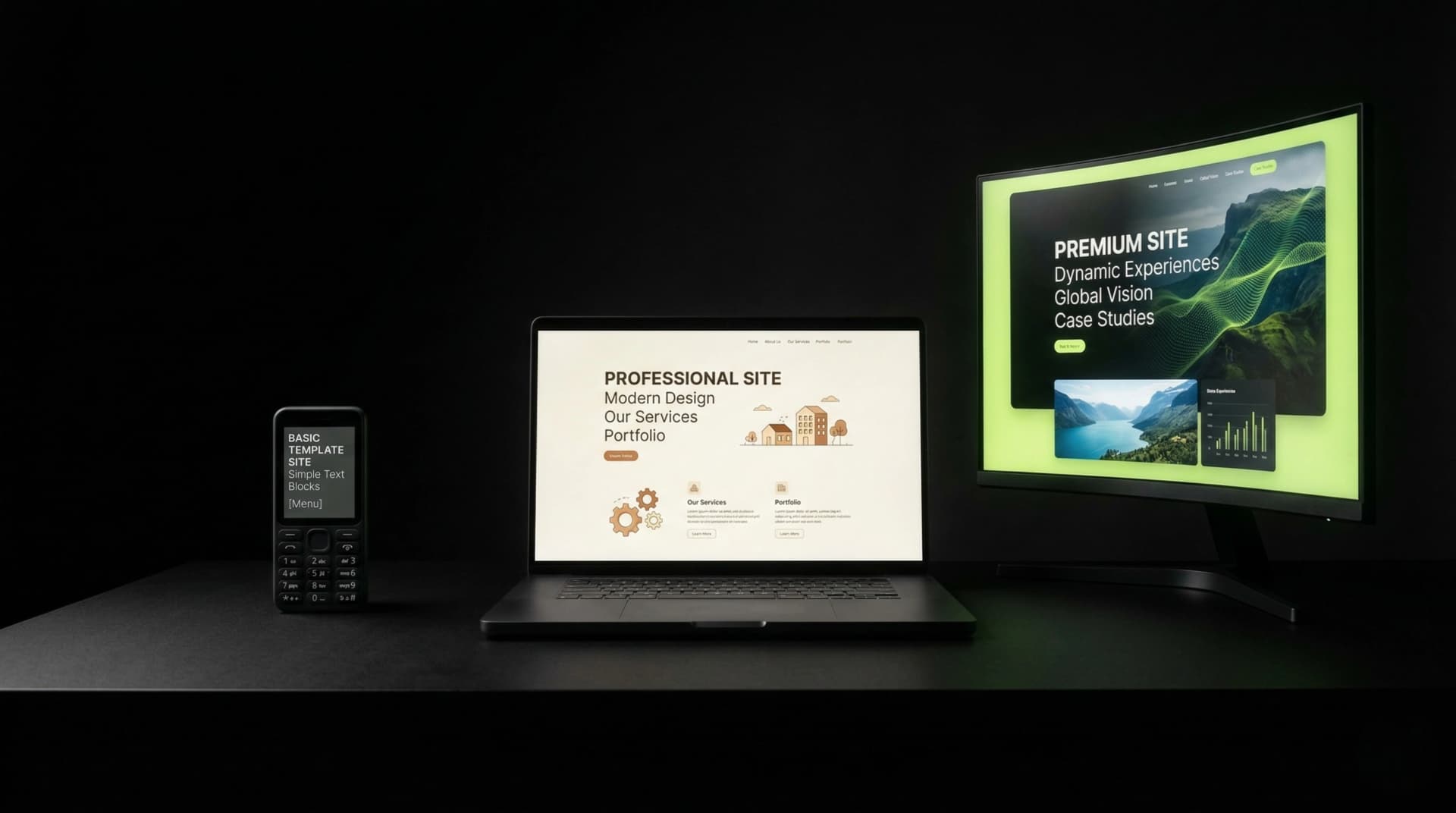

The honest answer is: it depends.
But that's the answer every article gives you before listing a bunch of ranges so wide they're useless. "$500 to $50,000" doesn't help anyone make a decision. You need to know what you're actually getting at each price point - and more importantly, what you're giving up.
So here's the breakdown. No fluff. Real numbers. What each option includes, what it doesn't, and what it actually means for your business.
The real question isn't "how much" - it's "what for"
Before you look at a single price, you need to answer one question: what do you need this website to do?
A website that exists so you can put the URL on your business card is a completely different product than a website that needs to show up on Google, convert visitors into clients, and work as the digital front door of your business.
Most articles about website cost treat all websites the same. They're not. A brochure is not a storefront. A template is not infrastructure. And the price difference between them isn't about aesthetics - it's about what the website does after it's built.
The cost of a website is not the cost of building it. It's the cost of what it produces - or fails to produce - every month it's live.
Tier 1: DIY website builders ($0 - $300/year)
Platforms: Wix, Squarespace, GoDaddy, WordPress.com (hosted)
What you get
A template-based website you build yourself. Drag-and-drop editor. Pre-designed layouts. Basic hosting included. Often a free plan available with the platform's branding on your domain (yourname.wixsite.com).
Typical costs
- Free plan: $0 (with platform branding and no custom domain)
- Basic plan: $12-$25/month ($144-$300/year)
- Custom domain: $10-$20/year
- Premium template: $0-$80 (one-time)
What you actually get for this money
A website that technically exists. It has pages, it loads, you can put your phone number on it. If someone types your exact URL into their browser, they'll find you.
What you don't get
SEO optimization. Custom design. Fast load speeds. Professional copywriting. Schema markup. Mobile optimization beyond whatever the template provides. Analytics integration. Conversion optimization. Technical support when something breaks.
Who this is for
Someone who genuinely just needs a digital placeholder - a URL to put on a business card. A hobby project. A side business that doesn't depend on digital clients. If your business grows entirely through in-person relationships and you'll never need a client to find you through Google, this works.
Who this is not for
Any business that depends on being found online. Any business where a referred client might Google your name before calling. Any business where the website is the first impression.
The hidden risk
A DIY website that looks amateur doesn't just fail to attract clients - it actively repels them. When a referred prospect Googles your name and finds a template site with stock photos and broken formatting, they don't think "this person saved money on their website." They think "this business doesn't seem professional." The cost of the website was $200. The cost of the lost client was $3,500.
Tier 2: Freelance designer or small studio ($1,500 - $8,000)
What you get
A custom-designed website built by a professional. Usually 5-10 pages. Custom layout, real branding, professional photos integrated, mobile responsive. Most freelancers work in WordPress, Webflow, or Squarespace and deliver a finished site in 4-8 weeks.
Typical costs
- Simple site (5 pages, template-based with customization): $1,500-$3,000
- Mid-range site (8-10 pages, custom design, basic SEO): $3,000-$5,000
- Premium freelance (custom everything, copywriting, strategy): $5,000-$8,000
- Ongoing maintenance: $50-$200/month
What you actually get
A site that looks professional and represents your brand well. A freelancer who listens to what you want and builds it. Something you can show to clients and feel good about.
What varies wildly
This is where the market gets chaotic. A $3,000 freelance website can be incredible or terrible depending entirely on the freelancer. Some deliver pixel-perfect design with solid technical foundations. Others deliver a pretty template with your logo pasted on top.
The questions to ask any freelancer
- Will the site be optimized for Google (title tags, meta descriptions, schema, sitemap)?
- What's the mobile load speed going to be?
- Who writes the copy - me or you?
- What happens after launch? Do I get support?
- Will I own the site if we stop working together?
If they can't answer these clearly, the price doesn't matter. You're buying a design, not a business tool.
Who this is for
Established businesses that need a professional online presence and have the budget for quality. Service businesses where the website needs to build trust - law firms, dental practices, consulting firms, agencies.
The gap at this tier
Most freelancers are designers, not strategists. They'll build what you ask for - but they won't tell you what you should be asking for. The site might look great and still not show up on Google because nobody thought about SEO during the build. It might have beautiful pages and zero conversion strategy because nobody asked "what happens after someone lands here?"
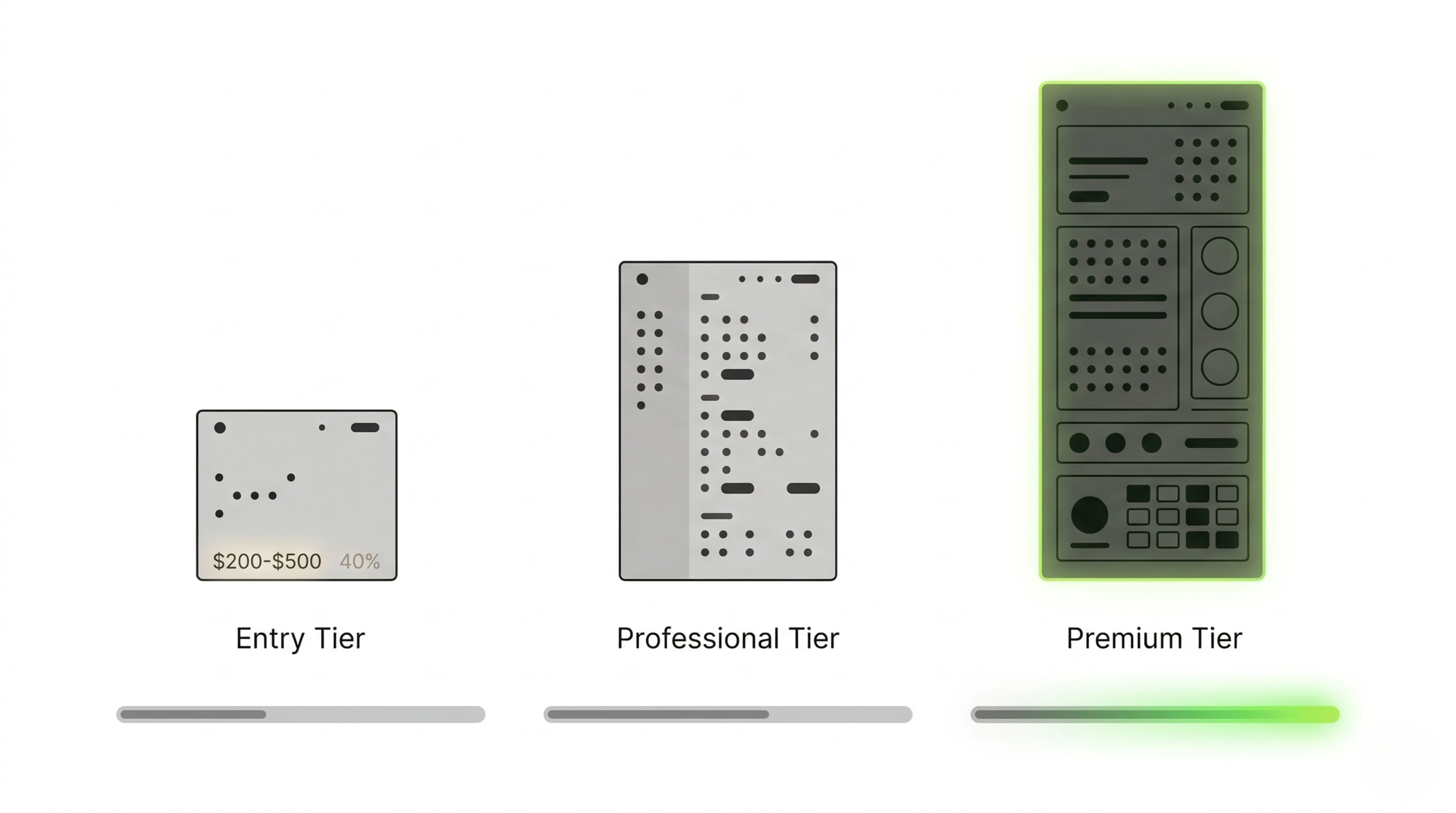
Tier 3: Agency ($10,000 - $50,000+)
What you get
A full-service website project. Strategy, design, development, copywriting, SEO, launch, and often ongoing management. A team works on your project - a strategist, a designer, a developer, a copywriter, a project manager.
Typical costs
- Standard agency site (10-20 pages): $10,000-$20,000
- Premium agency (custom design, advanced functionality): $20,000-$35,000
- Enterprise or e-commerce: $35,000-$50,000+
- Ongoing retainer: $500-$5,000/month
What you actually get
A website built with strategic intent - not just what looks good, but what works. User research informs the layout. Conversion goals shape the design. SEO is built into the architecture from day one. The copy is written by someone who knows how to make people take action.
The premium you're paying for
Process. Accountability. Strategy. A freelancer builds what you tell them. An agency figures out what should be built and why. That strategic layer is what separates a $5,000 site from a $25,000 site - and often, it's what separates a site that generates clients from a site that generates compliments.
Who this is for
Businesses where the website is a primary revenue driver. Companies with the budget to invest in infrastructure, not just aesthetics. Businesses that want a partner, not just a vendor.
The risk at this tier
Overpaying for aesthetics. Not every agency delivers strategy. Some charge $25,000 for the same template-based site a freelancer would build for $5,000, but with nicer meeting rooms and a heavier proposal. The price tag doesn't guarantee results. Due diligence matters here more than anywhere.
The question that cuts through the noise
Ask the agency: "Show me a client website you built and the business results it produced." Not traffic. Not design awards. Business results - leads generated, clients acquired, revenue attributed. If they can't answer this, they're selling design. Not infrastructure.
The option no one talks about: infrastructure as a service
There's a fourth model that's emerged in recent years, and it sits between freelancer and agency - but with a fundamentally different philosophy.
Instead of charging $15,000 upfront for a project, some firms charge a monthly fee ($300-$1,500/month) that covers the website, hosting, maintenance, ongoing SEO, and conversion optimization. You don't own the website outright - you subscribe to the infrastructure.
The advantage: Lower upfront cost. Continuous improvement instead of "build and forget." Aligned incentives - the firm only keeps getting paid if the website keeps working for you.
The disadvantage: You don't own the asset. If you stop paying, you lose the site. Some business owners are uncomfortable with this model for good reason.
Who this is for: Small businesses that can't afford $15,000 upfront but need more than a DIY template. Businesses that want ongoing support without managing a separate freelancer for every update.
This model works best when the firm is transparent about what you're getting, what happens if you leave, and how the ongoing work is structured. If the terms are clear and the results are measurable, it can be the highest-value option for many small businesses.
The costs nobody mentions
The sticker price is one thing. But a website has ongoing costs that most people don't budget for:
Hosting: $5-$50/month for standard hosting. $50-$200/month for managed hosting with CDN and security.
Domain renewal: $10-$20/year. Don't let this lapse. Losing your domain is a nightmare that costs far more than the renewal fee.
SSL certificate: Usually included with modern hosting. If not, $50-$200/year. Without it, browsers show a "Not Secure" warning - which kills trust instantly.
Maintenance and updates: WordPress sites need plugin updates, security patches, and PHP version upgrades. Budget $50-$200/month for someone to manage this, or learn to do it yourself.
Content updates: Your website isn't a brochure you print once. Services change. Prices change. Team members change. A website that hasn't been updated in 18 months signals to both Google and clients that the business might not be active.
Photography: Stock photos cost you credibility. Professional photography for your team, your space, and your work costs $500-$2,000 but pays for itself in trust.
Copywriting: If your freelancer or agency doesn't include copy, hiring a professional copywriter runs $500-$3,000 depending on the number of pages and the depth of research.
Add it all up and the true cost of maintaining a professional website is roughly $1,200-$4,000 per year on top of the initial build. Budget for this from day one.
So... do you even need a website?
This is a fair question. If your business is doing fine without one - clients come through referrals, you're at capacity, you're not trying to grow - maybe you don't. Not every business needs a website right now.
But here's what you need to consider:
140 people search "do I need a website for my business" every month. They're asking because they already suspect the answer is yes. And here's why:
Your referrals are researching you. Even if every client comes through word of mouth, the referred prospect Googles your name before calling. What they find - or don't find - determines whether the referral converts.
Your competitors have websites. When someone searches for your service in your area, the businesses with websites and Google Business Profiles show up. The ones without don't. Every search where you're absent is a client your competitor didn't earn - they inherited.
Your credibility is judged digitally. A website isn't a luxury. In 2026, it's the baseline expectation. Not having one doesn't make you mysterious - it makes you invisible.
The question isn't "do I need a website?" The question is: "How many clients am I losing because I don't have one - or because the one I have isn't doing its job?"
How to decide what's right for your business
Don't start with budget. Start with these three questions:
1. How do your clients find you?
If 100% come from referrals, your website's primary job is to convert referred prospects - not generate new ones. That changes the requirements significantly.
2. What happens when someone Googles your business name?
Do this right now. Incognito browser. Your business name. If what you see doesn't match the quality of your service - that's your answer.
3. What's a new client worth to you?
If a new client is worth $800/year, losing 3 per month to a bad digital presence costs $28,800/year. If they're worth $3,500, that number is $126,000. Suddenly the "expensive" website option looks different.
The right investment isn't the cheapest one. It's the one that stops the leak.
Not sure what you're losing?
The Infuser Digital Credibility Census calculates exactly that. You answer 13 questions about your business, your clients, and your digital presence. In return, you get a personalized score, an estimated monthly revenue impact, and a clear picture of where the gap is.
It's not a quote. It's not a sales call. It's math - applied to your specific business.

Want to know exactly how this is affecting your business?
The Digital Credibility Census calculates your estimated monthly loss using your data. 5 minutes, free.