


Your best clients talk about you.
They recommend you at dinners, text your name to colleagues, drop your business card at networking events. Word of mouth built your business. It's the reason you have clients today. And if someone told you that referrals are a problem, you'd probably laugh.
But here's what nobody tells you about referrals.
They don't end at the recommendation.
What really happens after someone says "check them out"
Picture this. A colleague tells a friend: "I know a great accountant. Look them up." The friend says thanks, pulls out their phone, and types the business name into Google.
Right there - between the recommendation and the phone call - is a gap most business owners don't know exists.
What happens in that gap decides everything.
If the friend finds a professional website with clear services, real testimonials, and a visible way to get in touch, they call. They book. They become a client.
If they find a bare-bones page, a social media profile with no link out, a site that looks like it was built in 2014, or worse - nothing at all - they close the browser. Move on. Never call.
And you never know that person existed.
No complaint. No feedback. No signal. Just silence.
This is the silent leak. And it's happening to referral-dependent businesses every single day.
Referrals are the best lead source. But they're not a strategy.
Let's be clear: word of mouth is not the problem. It's the most powerful form of client acquisition there is. A referred client arrives with built-in trust, higher lifetime value, and lower acquisition cost than any paid channel.
The data backs this up. According to Nielsen, 92% of consumers trust recommendations from people they know over any other form of advertising. Referred customers have a 16% higher lifetime value than non-referred ones (Wharton School of Business). And the close rate on referral leads is 3-5x higher than cold leads.
So if referrals are this powerful, why would anyone need to change anything?
Because referrals give you attention. They don't give you infrastructure.
The recommendation gets someone interested. But the moment that person decides to verify - to Google your name before calling - the referral has done its job. What happens next depends entirely on what they find.
And that part has nothing to do with how good your service is.
The math no one does
Let's make this concrete.
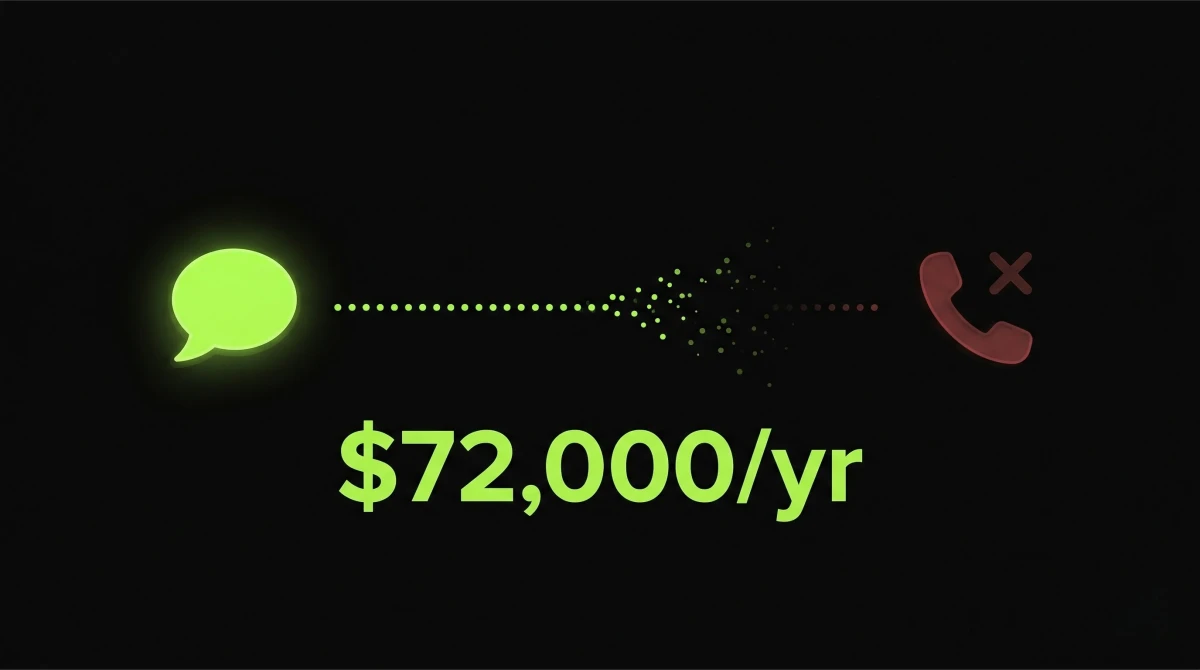
Say you're a dental practice that gets 25 referrals per month. The average value of a new patient is $1,200 per year. If even 20% of those referred prospects search your name and leave before making contact - because what they found didn't match the quality of the recommendation - here's what that looks like:
- 5 lost patients per month
- $6,000 in monthly revenue lost
- $72,000 per year - gone. Silently.
Now run this for your own business. How many referrals do you get per month? What's the average value of a new client? If 1 in 5 of those people searched your name and decided not to call - how much is that costing you?
The uncomfortable truth: the better your reputation offline, the more you have to lose from a weak digital presence. Because more referrals mean more people Googling your name. And every one of those searches is a moment of judgment.
Why most "referral marketing strategies" miss the point
If you search for referral marketing strategies (which is probably how you got here), most articles will tell you to:
- Create a referral program with incentives
- Ask clients for referrals at the right time
- Offer discounts for successful referrals
- Use referral software to automate tracking
- Build a reward tier system
These are fine tactics. But they all focus on generating more referrals - getting more people to recommend you.
None of them address what happens after the referral is made.
You could double your referral volume tomorrow and still lose 20% of them in the gap between the recommendation and the contact. More referrals flowing through a broken funnel just means more waste.
The real referral marketing strategy isn't about getting more recommendations. It's about making sure every recommendation converts.
What a referral actually needs to convert
When someone receives a referral and searches your business name, they go through a rapid trust verification process. It takes about 8 seconds. Here's what they check - whether they realize it or not:
1. Google results for your business name.
Does a professional website show up? Is there a Google Business Profile with reviews, hours, and photos? Or is there a digital void - scattered social profiles, no website, maybe a directory listing from 2019?
2. Your website (if it exists).
Does it load fast on mobile? Can they immediately understand what you do, who you serve, and how to get in touch? Are there real testimonials from people like them? Or is it a template that could belong to any business in any industry?
3. Social proof.
Reviews on Google, client logos, case studies, before-and-after results. Anything that confirms the recommendation they received. The friend said "they're great" - the website needs to prove it.
4. Contact pathway.
Can they call, email, or book in under 10 seconds? Or do they need to dig through three pages to find a phone number?
If any of these checkpoints fail, the prospect doesn't think "this business has a bad website." They think "maybe the recommendation was wrong." And they leave.
Your digital presence is the bridge between the referral and the revenue. Without it, the bridge has a hole. And clients fall through it silently, every day.
How to close the gap: 5 things that actually work
1. Search yourself before anyone else does
Open an incognito browser. Type your business name. Look at the results as if you've never heard of this company before. Ask yourself: would you call?
Most business owners have never done this. And the ones who do are often surprised - not by how bad it looks, but by how little shows up.
2. Claim and optimize your Google Business Profile
This is free and takes 30 minutes. Add your hours, services, real photos (not stock), and respond to every review. A complete Google Business Profile is the single most impactful thing you can do for branded search visibility.
3. Build a website that converts referrals - not just one that exists
A referral-ready website isn't about being flashy. It's about answering three questions in under 5 seconds: What do you do? Who is it for? How do I get in touch?
Add testimonials. Add real photos of your work. Make the phone number and contact form visible on every page. Mobile-first - because the person who just got your referral is searching from their phone at a dinner table.
4. Connect your offline reputation to your online presence
If you have 13 years of experience, 93 clients, and a professional certification - that needs to be visible when someone searches your name. Your digital presence should reflect the credibility your work has already earned.
5. Measure the gap
You can't fix what you can't see. You need to know how many referrals are leaking - and where. This means understanding what people see when they search your name, how your site performs on mobile, and where the conversion bottlenecks are.
The takeaway
Referrals are not going anywhere. They're the foundation of your business and they should be. But referral marketing in 2026 isn't just about generating more recommendations - it's about building the infrastructure that makes sure every recommendation turns into a client.
The gap between the referral and the phone call is invisible. You can't see it in your books. You can't find it in any report. But it's there. And every day it stays open, it costs you money.
The businesses that close this gap don't just grow - they grow predictably. Because every referral that comes in has a clear digital pathway to conversion. No more hoping the client calls. No more losing people you never knew existed.
Your referrals are already working. Make sure your digital presence doesn't undo them.
Not sure how much the gap is costing you?
The Infuser Digital Credibility Census takes 5 minutes. You answer 13 questions about how your clients find you, what they see when they search your name, and the financial impact of what's happening today.
At the end, you get a personalized score from 0 to 100, an estimated monthly loss, and a clear picture of what needs to be fixed first.
No sales pitch. No commitment. Just the math.
Want to know exactly how this is affecting your business?
The Digital Credibility Census calculates your estimated monthly loss using your data. 5 minutes, free.