

Someone in your city just searched for exactly what you sell.
They typed it into Google. They looked at the results. They picked a business, called them, and booked an appointment.
It wasn't yours.
Not because your service is worse. Not because your prices are higher. Not because you're farther away. You didn't show up. So you were never even an option.
This happens hundreds of times a day to small businesses with great reputations and zero local search visibility. And the worst part is - you'll never see it in any report. There's no "clients who almost called you" metric.
But there is a way to fix it. That's what this guide is for.
What is local SEO (and why should you care)?
Local SEO is the practice of making your business visible when someone nearby searches for what you offer.
When a person types "dentist near me," "best Italian restaurant downtown," or "emergency plumber" into Google, the results they see are determined by local SEO signals - not just who has the best website, but who has the most relevant, trustworthy, and complete digital presence for that specific location.
Here's why it matters more than most marketing you've ever considered:
76% of people who search for something "near me" visit a business within 24 hours. Not within a week. Within a day. And 28% of those searches result in a purchase. This isn't browsing traffic. This is people with their wallet in their hand, looking for someone to give it to.
The question isn't whether local SEO matters. The question is whether you're the business they find - or the business they skip.
The three places Google shows local results
Before we get into tactics, you need to understand where local results actually appear. Google doesn't show one set of results. It shows three:
1. The Map Pack (Local Pack)
The top section with the map and three business listings. This gets roughly 42% of all clicks on local search results. If you're in the Map Pack, you're winning. If you're not, most searchers never scroll past it.
2. Organic results
The traditional blue links below the Map Pack. These are influenced by your website's SEO - content, structure, backlinks, speed. Being in both the Map Pack AND organic results is the gold standard.
3. Google Ads (Paid)
The "Sponsored" results at the very top. These cost money per click - and for local services, the cost is steep. The average CPC for "local SEO for small business" is $33.37. That's per click, not per client. Organic visibility doesn't cost per click. It costs effort upfront, then pays indefinitely.
Your goal is to dominate the first two - Map Pack and organic - without relying on the third.
Step 1: Claim and optimize your Google Business Profile
If you do nothing else from this guide, do this.
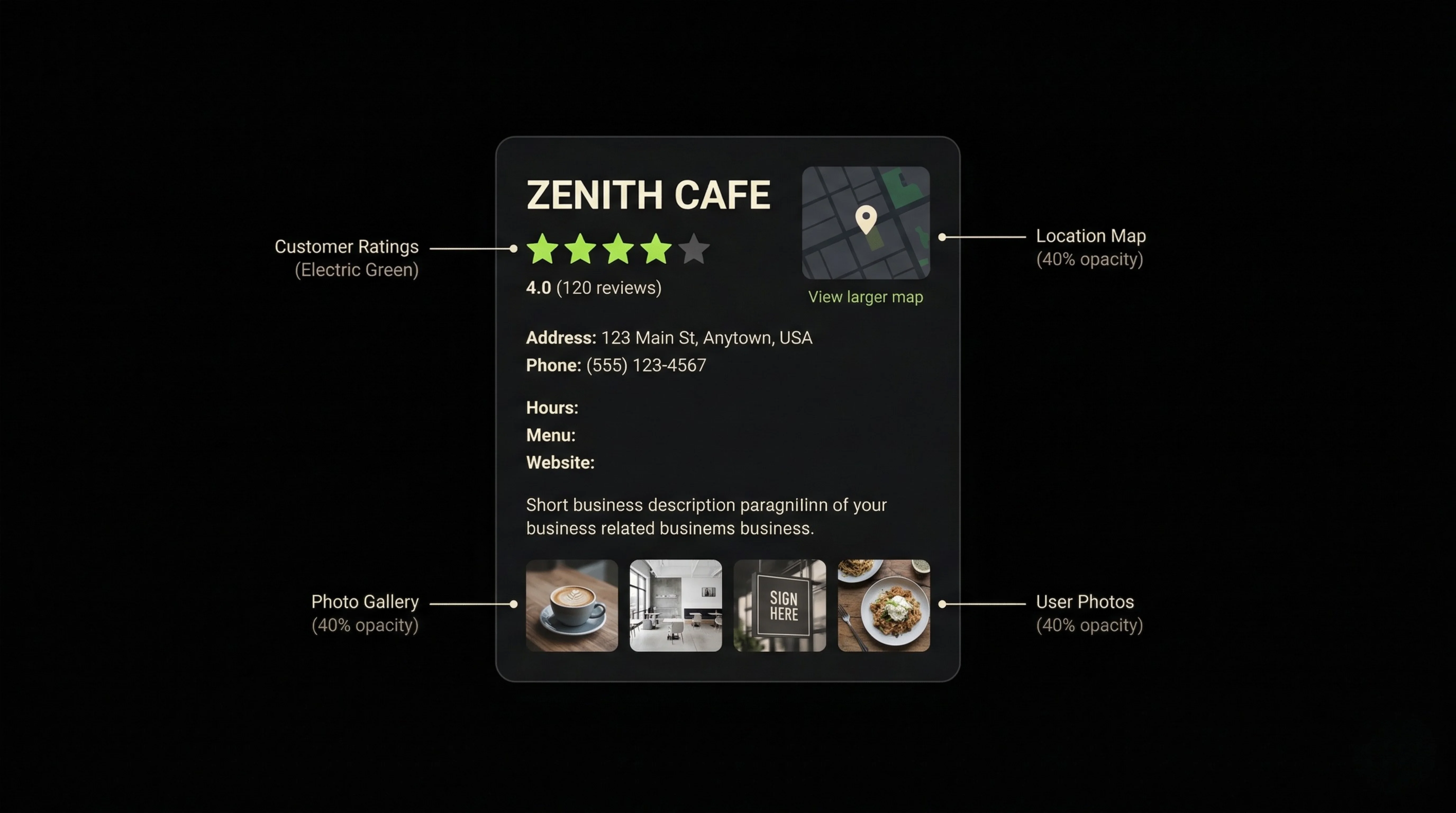
Your Google Business Profile (GBP) - formerly called Google My Business - is the single most important factor in appearing in the Map Pack. It's free. It takes about 30 minutes to set up properly. And a fully optimized GBP outperforms most websites for local search queries.
Here's how to set it up right:
Business name: Use your real business name. Don't stuff keywords into it ("John's Plumbing - Best Emergency Plumber Dallas" will get you flagged). Just your actual business name.
Categories: Pick the most specific primary category that matches your core service. Then add 2-4 secondary categories. Google offers hundreds - don't just pick "Professional Services" when "Immigration Law Firm" is available.
Description: Write 750 characters that clearly describe what you do, who you serve, and where. Include your city naturally. This isn't the place for marketing fluff - it's the place for clarity.
Hours: Keep them current. Always. Nothing kills trust faster than a customer driving to your location based on Google hours and finding a locked door. Update holiday hours proactively.
Photos: Upload at least 10 real photos. Your storefront (exterior and interior), your team, your work. Not stock images. Google has confirmed that businesses with photos get 42% more requests for directions and 35% more clicks to their website. Real photos signal real business.
Services and products: Fill out every service you offer with descriptions and prices where applicable. This gives Google more context to match you with relevant searches.
Q&A section: Preload this with your most common questions - and answer them yourself. If you don't, random people might answer for you. And they might be wrong.
Posts: Google lets you publish posts directly on your profile - updates, offers, events. Businesses that post regularly signal to Google that they're active and engaged. Aim for at least one post per week.
Step 2: Get consistent on NAP
NAP stands for Name, Address, Phone Number. It sounds simple. It's deceptively important.
Google cross-references your business information across the entire internet. When your name, address, and phone number are identical everywhere - your website, your GBP, Yelp, the BBB, your Facebook page, industry directories - Google trusts that you're a real, legitimate business at that location.
When the information is inconsistent - different phone numbers on different platforms, your street address abbreviated in one place and written out in another, an old address you forgot to update - Google gets confused. And confused Google means lower rankings.
How to fix it:
Start by Googling your business name and checking every listing that appears. Make a spreadsheet. Note every variation. Then systematically update each one to match your GBP exactly.
The most common offenders: an old phone number on Yelp, a previous address on your Facebook page, a different business name format on an industry directory ("John Smith, DDS" vs "Dr. John Smith Dental").
One format. Everywhere. No exceptions.
Step 3: Build your website for local search
Your GBP gets you into the Map Pack. Your website gets you into organic results. Together, they create a complete local presence that's hard for competitors to beat.
Here's what a locally-optimized website needs:
Location in title tags. Your homepage title should include your primary service and your city. Not "Welcome to Our Website." Something like "Family Dentist in Austin, TX - Bright Smile Dental." Every service page should follow the same pattern.
Dedicated service pages. Don't put all your services on one page. Create a separate page for each core service. "Teeth Whitening in Austin" and "Emergency Dental Care Austin" are two different search queries with two different audiences. One page per service = one opportunity per search query.
A real About page. Your story. Your credentials. Your team photos. How long you've been in business. This isn't vanity - it's E-E-A-T (Experience, Expertise, Authoritativeness, Trustworthiness), which Google explicitly uses to evaluate local business websites.
Contact page with embedded map. Your address, phone number, email, and a Google Maps embed. Make it easy for Google to confirm your location - and easy for clients to find you.
Mobile-first design. Over 60% of local searches happen on mobile. If your site breaks on a phone - slow load, tiny text, buttons too small to tap - Google penalizes you in mobile rankings. And the person who was about to call you leaves instead.
Schema markup. This is the technical part most small business websites are missing entirely. Schema (specifically LocalBusiness schema) is structured data that tells Google exactly what your business is, where it's located, what hours you're open, and what services you provide - in a format Google can read instantly. Adding schema markup to your site gives you an immediate competitive advantage because most of your local competitors don't have it.
Step 4: Get reviews (and respond to every single one)
Reviews are the third pillar of local SEO, after your GBP and your website.
Google has directly stated that review quantity, velocity, and diversity are ranking factors for local search. Translation: more reviews, posted regularly, across multiple platforms = higher rankings.
But reviews do something even more important than rankings: they convert searchers into clients. 87% of consumers read online reviews for local businesses. And the business with 47 reviews and a 4.6-star rating will always beat the business with 3 reviews and a perfect 5.0.
How to get reviews systematically:
Don't wait for reviews to happen organically. Build it into your process:
After every completed service, send a follow-up text or email with a direct link to your Google review page. You can generate this link from your GBP dashboard. Make it one tap. Make it easy.
Time it right - ask when the client is happiest. Right after a successful outcome, not two weeks later.
Don't incentivize reviews with discounts or gifts. Google prohibits this and can flag your profile.
How to respond:
Respond to every review - positive and negative. For positive reviews, a brief thank-you personalizing something specific ("Thanks for trusting us with your kitchen remodel, Maria") shows future clients that you're engaged and attentive.
For negative reviews, respond calmly, acknowledge the issue, and offer to resolve it offline. Never argue publicly. The response isn't really for the unhappy client - it's for the hundreds of future clients reading it.
Step 5: Build local citations and backlinks
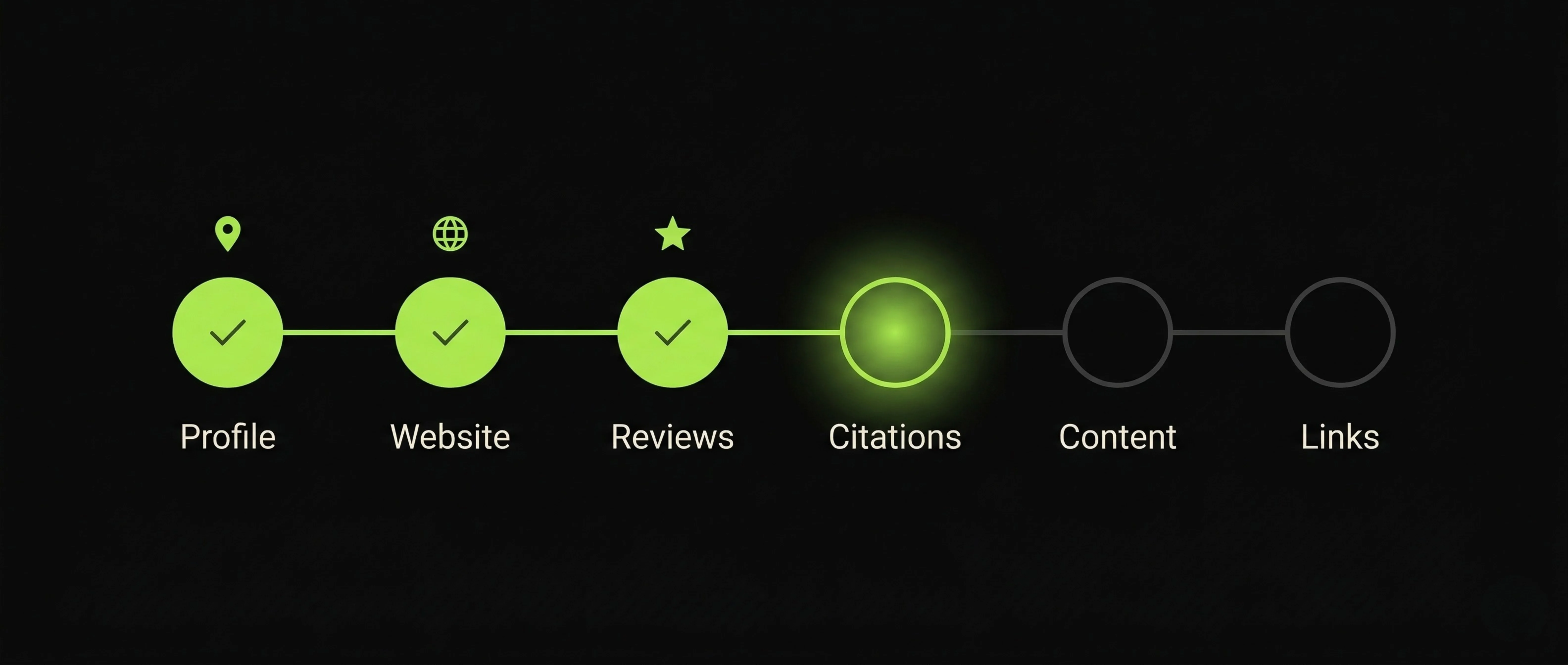
Citations are mentions of your business on other websites - directories, review sites, industry associations, local news. Backlinks are when those mentions include a link to your website.
Both send signals to Google: this business exists, it's located here, and other credible sources vouch for it.
Start with the essentials:
- Google Business Profile (already done)
- Yelp
- Apple Maps
- Bing Places
- Facebook Business Page
- Your industry's main directory (Avvo for lawyers, Healthgrades for doctors, Houzz for contractors, TripAdvisor for restaurants)
- Better Business Bureau
- Local Chamber of Commerce
Then build local backlinks:
- Sponsor a local event - most post sponsor logos with links
- Write a guest article for a local news outlet or blog
- Partner with complementary local businesses and cross-link
- Create a genuinely useful local resource (a neighborhood guide, a seasonal checklist for your industry) that local sites want to reference
For local SEO, 10-20 quality local backlinks are more valuable than 500 random links from irrelevant websites. Quality and relevance beat quantity.
Step 6: Create local content that ranks
Content marketing isn't just for tech companies with blogs. For local businesses, the right content can capture searches your competitors don't even know exist.
The types of content that work for local businesses:
Service + location pages. If you serve multiple neighborhoods or cities, create a dedicated page for each. "Emergency Plumbing in South Austin" and "Emergency Plumbing in Round Rock" are different searches with different competition levels.
FAQ pages. Answer the questions your clients actually ask - in their words, not yours. "How much does a dental crown cost in Austin?" is a real search query. If you answer it honestly on your website, you have a chance to rank for it.
Industry-specific guides. "How to prepare for your first visit to an immigration lawyer" or "What to expect during a home inspection in Texas." These establish expertise, capture informational searches, and build trust before the client ever calls.
Seasonal content. "Summer AC maintenance checklist for Austin homeowners" or "Tax prep deadlines for small businesses in 2026." These capture seasonal spikes and position you as the go-to local resource.
Every piece of content you publish is a new door into your business. The more doors, the more ways people can find you.
How much does local SEO cost?
This is one of the most searched questions in this space - and one of the most confusing to answer. So let's break it down honestly.
If you do it yourself:
The cost is zero dollars and significant time. Setting up your GBP, optimizing your website, getting reviews, building citations - all of this can be done without paying anyone. But it requires learning, consistent effort, and technical comfort. Expect to invest 5-10 hours upfront and 2-3 hours per week ongoing.
If you hire an agency or freelancer:
Local SEO services typically range from $300 to $2,000 per month, depending on your market, competition level, and scope. On the low end, you get basic citation management and GBP optimization. On the high end, you get content creation, link building, and ongoing technical SEO.
The question to ask: Not "how much does it cost" but "how much is it costing me to not show up?" If you're a law firm and one new client is worth $3,500 - and you're invisible for every local search - the cost of inaction dwarfs the cost of optimization.
Is SEO worth it for small businesses? The data says yes. Organic search drives 53% of all website traffic. And unlike paid ads, the traffic doesn't stop the moment you stop paying. SEO compounds. Every month of work makes the next month more effective.
What local SEO looks like for specific industries
The principles are universal. The application varies.
Restaurants: Your GBP is everything. Photos of food, updated menu link, correct hours, and recent reviews are the top ranking factors. Add schema for your menu. Post weekly specials as Google Posts. Respond to every review - especially negative ones about wait times or service.
Dental practices: Service-specific pages ("teeth whitening in [city]," "emergency dentist [city]") drive the most valuable traffic. Before-and-after photos on your GBP build trust. Insurance information on your website captures a high-intent search ("dentist that accepts Delta Dental in [city]").
Law firms: E-E-A-T matters more here than any other local industry. Attorney bios with real credentials, case results (anonymized), and client testimonials are essential. Create content around specific legal questions in your area ("How long does a divorce take in Texas?").
Home services (plumbing, HVAC, electrical): "Near me" searches dominate. Your GBP needs to show your service area clearly. Before-and-after project photos outperform any written testimonial. Speed of response matters - businesses that respond to inquiries within 5 minutes are far more likely to win the job.
Consulting and professional services: Trust is the conversion factor. Your website needs clear case studies, a strong About page, and testimonials from recognizable clients or companies. LinkedIn presence amplifies local SEO signals for professional services.
The 30-day local SEO action plan
If all of this feels overwhelming, here's the order. One step at a time. Each builds on the last.
Week 1: Foundation
- Claim and fully optimize your Google Business Profile
- Submit your website to Google Search Console
- Fix any NAP inconsistencies across your top 5 listings
Week 2: Website
- Add your city to every title tag and H1
- Create dedicated pages for your top 3 services
- Add LocalBusiness schema markup
- Ensure mobile load time is under 3 seconds
Week 3: Reviews and citations
- Ask 10 past clients for Google reviews
- Create listings on Yelp, Apple Maps, Bing Places, and your industry directory
- Respond to every existing review (positive and negative)
Week 4: Content and links
- Publish one FAQ page answering your top 10 client questions
- Reach out to one local organization for a backlink opportunity
- Post your first Google Business Profile post
Then repeat weeks 3 and 4 every month. Local SEO isn't a project - it's a practice. The businesses that show up consistently are the ones that work on visibility consistently.
The bigger picture
Local SEO isn't about gaming an algorithm. It's about making sure that when someone needs what you offer and searches for it, they find you instead of finding nothing - or finding your competitor.
Every tactic in this guide serves one purpose: closing the gap between your reputation and your visibility. You already do great work. Your clients already trust you. But the next client - the one who doesn't know you yet - is making a decision based on what Google shows them.
If what Google shows them is incomplete, outdated, or empty, the decision is already made. And it wasn't made in your favor.
The businesses that grow predictably in 2026 aren't just good at what they do. They're visible where it matters.
Find out where you stand - in 5 minutes
The Infuser Digital Credibility Census evaluates your local search visibility, your website performance, your review presence, and your overall digital credibility. You answer 13 questions. You get a score from 0 to 100, an estimated monthly revenue impact, and a clear priority list.
It covers everything in this guide - and tells you exactly which steps matter most for your specific business.
No sales pitch. No commitment. Just the numbers.
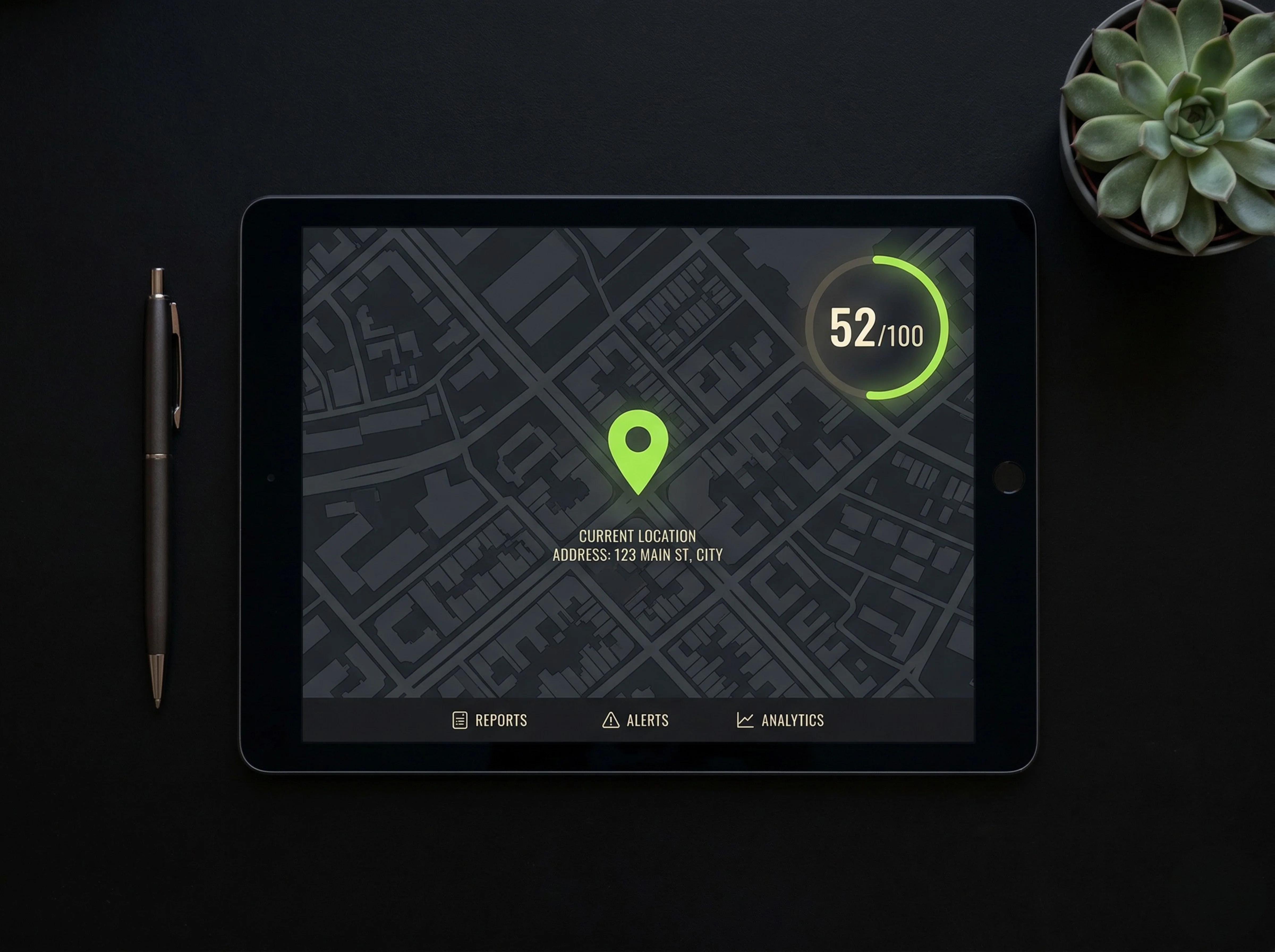
Want to know exactly how this is affecting your business?
The Digital Credibility Census calculates your estimated monthly loss using your data. 5 minutes, free.