


You don't have a marketing problem.
You have clients. People pay you. Some of them come back. Some of them send their friends. The business works.
But it could work better. And the gap between where you are and where you could be isn't about running ads, posting more on Instagram, or hiring a marketing agency. It's about something most business owners have never examined - the invisible infrastructure between someone hearing about you and someone becoming a client.
This article isn't about tactics that require a budget. It's about fixing the systems that are already supposed to be working - and making sure every potential client who finds you actually reaches you.
Why most advice about "getting more clients" is wrong
Search for "how to get more clients" and you'll find the same list recycled across hundreds of articles: run Facebook ads, post on social media daily, start a podcast, build an email list, attend networking events, launch a referral program.
These aren't bad ideas. But they all share the same assumption: your problem is that not enough people know about you.
For most small businesses, that's not the real problem.
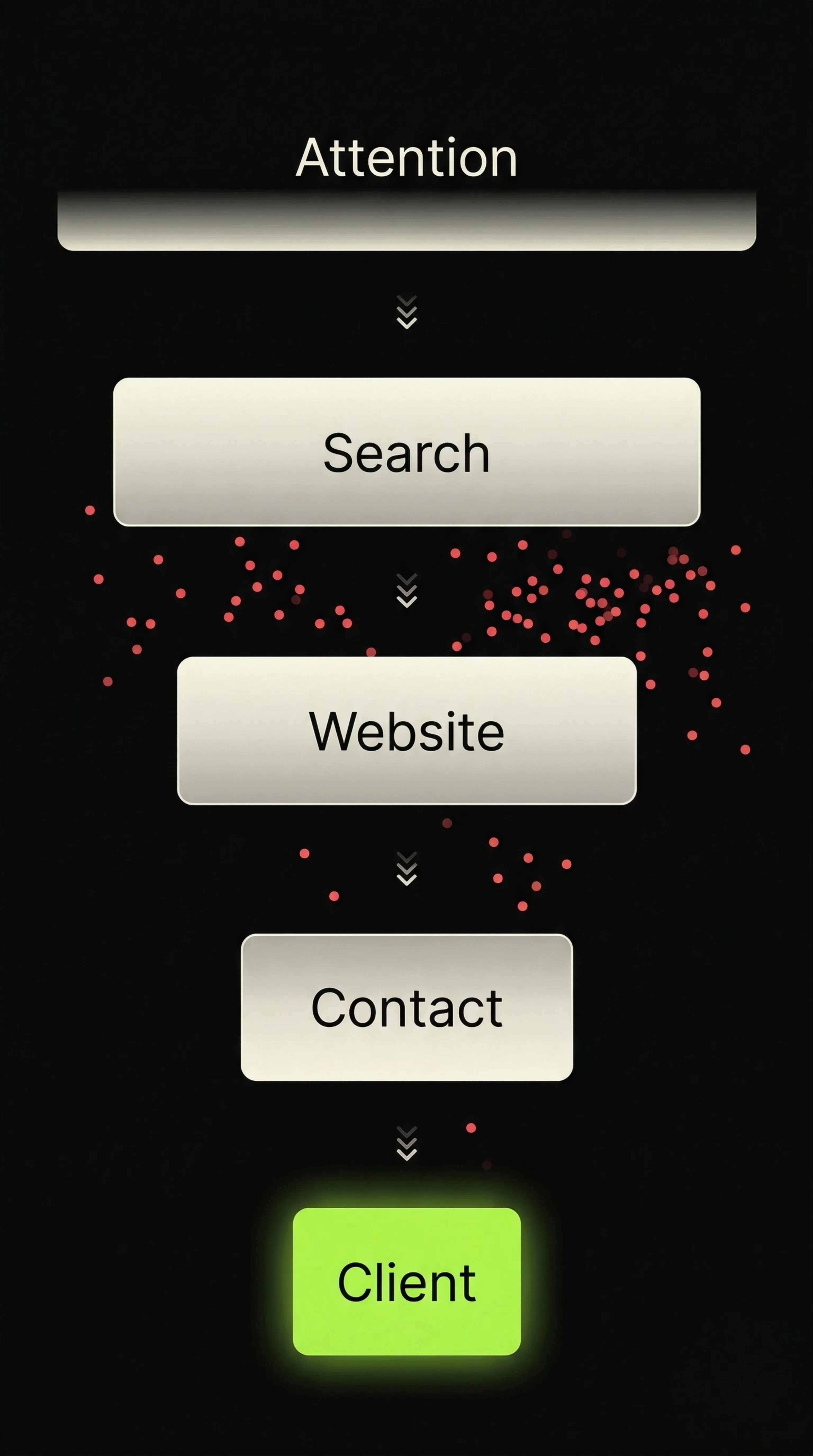
The real problem is that people already know about you - or are about to - and something breaks between the awareness and the action. They hear your name but can't find you online. They find your website but it doesn't convince them. They see your business on Google but there's nothing there that builds trust.
You don't need more visibility. You need more conversion from the visibility you already have.
The seven strategies below are organized in order of impact - starting with the one that produces results fastest and costs nothing.
Strategy 1: Fix what people see when they Google your name
This is the highest-leverage thing you can do. And almost nobody does it.
Open an incognito browser right now. Type your business name into Google. Look at the results. Not as the owner who knows the business inside and out - as a stranger who's hearing about you for the first time.
What do you see?
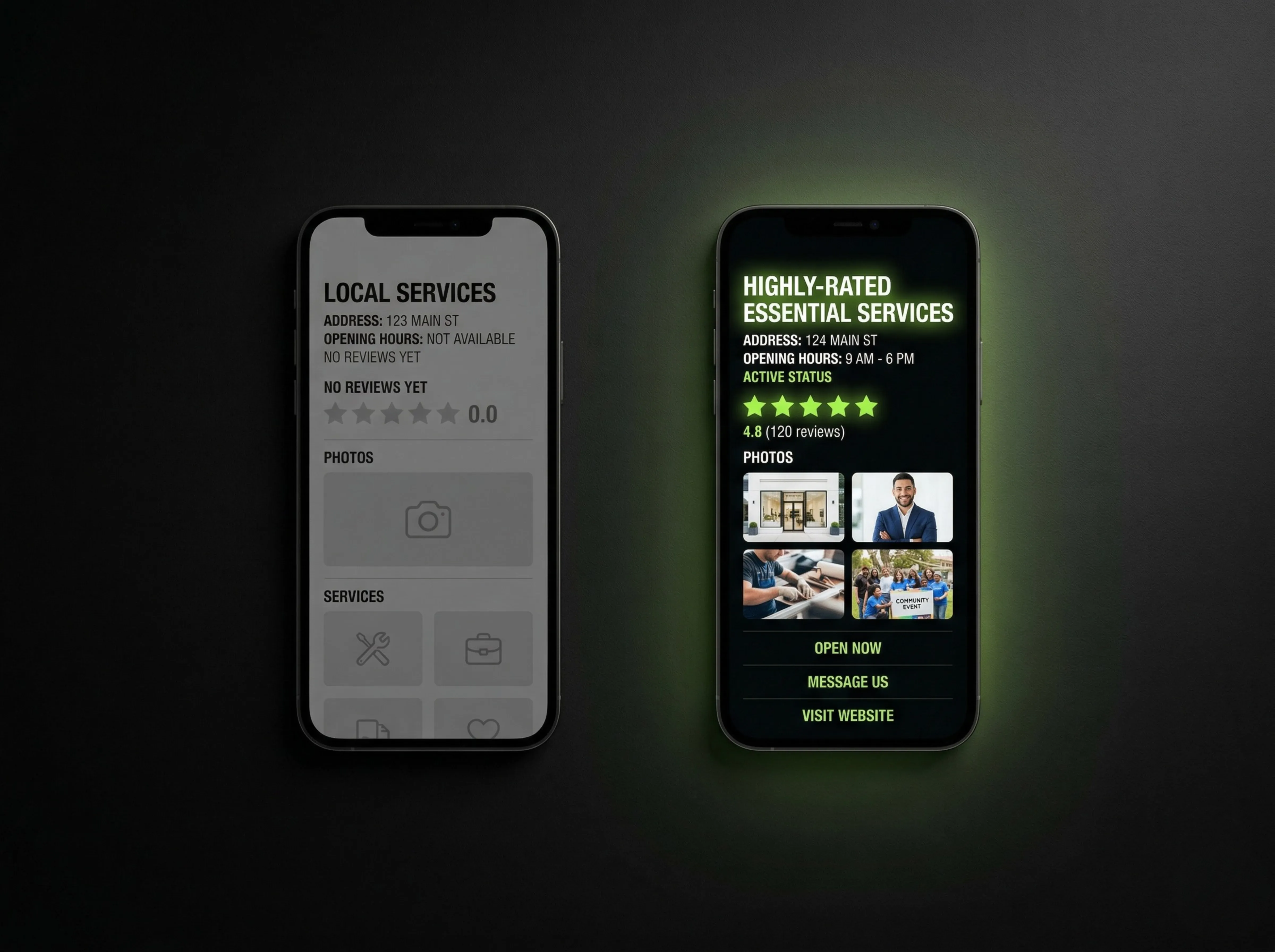
If the answer is a complete Google Business Profile with reviews, a professional website, and consistent information - good. You've already done more than most.
If the answer is a scattered mix of old directory listings, a social media page you haven't updated in a year, and no website - that's your problem. Not marketing. Not reach. Not visibility. The funnel is leaking at the bottom.
Every time someone hears about your business - through a referral, a networking event, a mention in conversation - the first thing they do is search your name. What they find in that moment determines whether they call or move on.
Action: Google your business name in incognito. Screenshot the results. Be honest about what a stranger would think. If it doesn't reflect the quality of your actual service, that's gap number one.
Strategy 2: Turn your existing clients into a referral system
You already get referrals. The question is whether you're getting them by accident or by design.
Most businesses treat referrals as something that happens passively - a nice bonus when a client mentions you to a friend. But referrals are the highest-quality lead source you have. Referred clients arrive with trust already built, close at 3-5x the rate of cold leads, and have a 16% higher lifetime value.
The problem is that most businesses have no system to encourage, track, or amplify referrals.
How to systematize referrals:
Ask at the right moment. The best time to ask for a referral is immediately after a positive outcome - when the client is most satisfied. Not in a generic email two weeks later.
Make it easy. Don't say "tell your friends about us." Say "if you know anyone who needs [specific service], I'd love an introduction. Here's my card - or just text them my number." Reduce the effort to zero.
Follow up on every referral. When a referred prospect contacts you, tell the referrer. "Maria, thanks for sending David our way - we're meeting next week." This does two things: it acknowledges the referrer (making them more likely to do it again) and it closes the loop.
But here's the part everyone misses: referrals only convert if your digital presence backs them up. Between the recommendation and the phone call, the referred prospect Googles you. If what they find doesn't match the recommendation, they don't call. You lose the client and you never know it happened.
Referral systems and digital infrastructure work together. One generates leads. The other converts them.
Strategy 3: Claim and optimize your Google Business Profile
If you're a local business without an optimized Google Business Profile, you're invisible for nearly half of all local searches.
42% of clicks on local search results go to the Map Pack - the three businesses shown with the map at the top. Your GBP is what puts you there. It's free. It takes 30 minutes to set up. And for most local businesses, it's the single most impactful thing you can do to get more clients without spending on ads.
The essentials:
- Claim your profile at business.google.com
- Choose specific categories (not generic ones)
- Write a 750-character description with your services, location, and differentiators
- Upload 10+ real photos (not stock)
- Get 10+ reviews with a direct link you send after every service
- Respond to every review - positive and negative
- Post weekly updates
A fully optimized GBP with consistent reviews will outperform a $2,000/month ad budget for many local businesses. And unlike ads, the results don't disappear when you stop paying.
Strategy 4: Build a website that converts - not just exists
Having a website and having a website that generates clients are completely different things.
A website that generates clients does three things in under 5 seconds: tells the visitor what you do, who it's for, and how to take the next step. Everything else - the design, the animations, the clever copy - is secondary to those three things.
What converts visitors into clients:
Clarity over cleverness. "Family Dentist in Austin - Same-Day Appointments Available" converts better than "Crafting Beautiful Smiles Since 2005." The first one answers questions. The second one says nothing.
Visible contact information on every page. Phone number in the header. Contact form above the fold. Click-to-call on mobile. If someone has to search for how to reach you, you've already lost them.
Testimonials near the call-to-action. Social proof reduces friction at the moment of decision. A testimonial next to the "Book Now" button is worth more than a testimonial on a separate page nobody visits.
Mobile-first everything. Over 60% of local searches happen on mobile. If your site doesn't load fast and work perfectly on a phone, you're losing the majority of your potential clients. Not some of them. Most of them.
Speed. 53% of mobile visitors leave a site that takes more than 3 seconds to load. Every second of load time costs you clients. Compress images, use modern hosting, eliminate unnecessary plugins.
A website that does these things becomes a client-generating asset - not an expense. The difference isn't design talent. It's strategic intent.
Strategy 5: Get found for what you do - not just who you are
Ranking for your business name is table stakes. The real opportunity is ranking for what you do - the service someone searches for when they don't know your name yet.
This is where content becomes a client acquisition tool.
The approach:
Create a page for every core service. Not one page with a list. A dedicated page with a clear title: "Emergency Plumbing in South Austin" or "Small Business Tax Preparation in Denver." Each page targets a specific search query and gives Google a reason to show you for it.
Answer the questions your clients actually ask. "How much does a dental crown cost?" or "What should I look for in a contractor?" or "Do I need a will if I'm under 40?" These are real searches. If you answer them better than anyone else, Google rewards you with traffic - and the people who find you arrive already trusting your expertise.
Think local. Add your city, neighborhood, or region to every title and heading. "Best practices for home inspection" gets lost in a sea of national content. "What to expect from a home inspection in Houston" targets a specific, reachable audience.
Every piece of content is a door. The more doors you create, the more ways people can find you. And unlike an ad that stops running, a well-written page continues generating traffic for years.
Strategy 6: Build your reputation before the client needs you
Trust isn't built at the moment of sale. It's built in the moments before the client even knows they need you.
The businesses that attract clients organically - without ads, without cold outreach - have something in common: they're visible and credible before the need arises. When the need hits, those businesses are already top-of-mind.
How to build pre-need trust:
Reviews. Not just quantity - consistency. A business with 50 reviews spread over three years looks different than a business with 50 reviews all posted in one month. Regular, authentic reviews signal an active, trustworthy business. Ask for one review per week. That's 52 per year. Most of your competitors aren't doing this.
Local visibility. Get listed in your Chamber of Commerce, your industry directory, your local business association. Sponsor a community event. Write a guest post for a local blog. Each mention builds a layer of credibility that compounds over time.
LinkedIn (for professional services). If you're a consultant, lawyer, accountant, or agency - LinkedIn is where your clients are before they become clients. Not posting sales pitches. Sharing insights, case studies, and perspectives on your industry. When they need someone, you're the name they remember.
Consistent presence, not viral moments. You don't need a post that gets 10,000 likes. You need to show up consistently for 6 months. Consistency beats virality every time for client acquisition. The business that posts something useful every week for a year will always outperform the business that went viral once and disappeared.
Strategy 7: Measure the gap - and close it
You can't improve what you don't measure. And most business owners have never measured the gap between their reputation and their visibility.
They know their service is good. They know clients are happy. But they don't know what happens when a potential client searches their name online. They don't know how their website performs on mobile. They don't know if their Google Business Profile is complete. They don't know how many referrals are leaking through the cracks.
The questions to answer:
What does someone see when they Google your business name? Not what you think they see. What they actually see. Incognito browser. Right now.
How fast does your website load on mobile? Run PageSpeed Insights. If the score is below 50, you have a problem.
How many Google reviews do you have? And how recent are they? A business with 40 reviews but none in the last 6 months looks dormant.
Can someone contact you from your website in under 10 seconds? Open your site on your phone. Time it. If finding the phone number or contact form takes more than two taps, you're losing people.
What's a new client worth to you annually? Now multiply that by the number of referrals, searches, and inquiries you might be losing each month. That's the cost of the gap.
Once you know the gap, closing it becomes a sequence of specific actions - not a vague "we should do more marketing" initiative.
The math behind "more clients"
Let's make this tangible.
Say you're a consulting firm. A new client is worth $8,000 per year. You get about 15 referrals per month through word of mouth.
If your digital presence is strong - professional website, optimized Google profile, consistent reviews - your referral conversion rate might be 85%. That's roughly 13 new clients per month. $104,000 in annual revenue from referrals alone.
If your digital presence is weak - no website or a bad one, sparse Google profile, few reviews - your conversion rate drops to 60-65%. That's 9-10 clients per month. $80,000 in annual revenue.
The difference? $24,000 per year. Not from getting more referrals. From converting the referrals you already have.
Now add the organic clients - people who find you through Google search, not referrals. With strong local SEO, that might be 3-5 additional clients per month. That's another $24,000-$40,000 per year.
The businesses that grow without ads aren't doing more marketing. They're converting a higher percentage of the attention they already receive. That's the difference.
The one thing all seven strategies have in common
Every strategy in this article - from fixing your Google results to building a review system to creating content - leads to the same place: making sure that when someone is ready to become a client, nothing stops them.
Not a missing website. Not a slow page. Not an empty Google profile. Not a referral that leaked because the prospect searched your name and found nothing.
Getting more clients isn't about doing more. It's about plugging the leaks in the system you already have.
The businesses that grow predictably - year after year, without depending on ads - are the ones that built the infrastructure to convert attention into clients. Every single time.
Find out where your clients are leaking
The Infuser Digital Credibility Census maps exactly where the gaps are. You answer 13 questions about your business - how clients find you, what they see when they search, how your website performs. In return, you get a score from 0 to 100, an estimated number of clients lost per month, and a priority list of what to fix first.
It's not theory. It's the math applied to your specific business.
Want to know exactly how this is affecting your business?
The Digital Credibility Census calculates your estimated monthly loss using your data. 5 minutes, free.